
Artificial saliva: When science helps restore comfort, protection, and quality of life
Saliva is usually only noticed when it is missing. While it is present in adequate quantity and quality, it works silently: it lubricates the mouth, protects the teeth, helps with speech, chewing, swallowing, taste, and the control of microorganisms. But when this function decreases, the impact appears quickly. The mouth becomes dry, sensitive, burning, and more vulnerable to cavities, infections, and sores, and simple activities such as talking, eating, or sleeping can become uncomfortable.
It is in this context that artificial saliva becomes important. More than a resource to simply “moisten the mouth,” it is part of a care strategy for patients facing xerostomia, hyposalivation, or significant changes in saliva quality. This condition may be related to cancer treatments, the use of certain medications, menopause, aging, systemic diseases, and changes in the salivary glands. The American Dental Association points out that dry mouth can range from mild discomfort to a condition capable of compromising health, nutrition, and quality of life, with an estimated prevalence of about 22% of the world population in a systematic review.
At Clínica Debora Ayala, this topic is treated with seriousness because saliva is not a detail. It is an essential part of oral health and, in many cases, of the patient’s overall health.
Saliva is not just water
Although it is composed mostly of water, saliva is much more complex than it seems. It contains minerals, enzymes, proteins, antibodies, and substances that help balance the pH of the mouth, neutralize acids, control microorganisms, and participate in the remineralization of dental enamel. In other words, it works as a constant protective layer.
When salivary production decreases or saliva becomes thicker and less effective, the mouth loses part of this natural shield. The mucosa becomes dry, the tongue may burn, the breath changes, chewing becomes more difficult, and the teeth begin to suffer more from the action of acids and bacteria. Reviews on xerostomia reinforce that saliva plays a central role in maintaining oropharyngeal health and that the persistent sensation of dry mouth can intensely affect quality of life.
Therefore, when we talk about artificial saliva, we are not just talking about temporary comfort. We are talking about trying to restore to the mouth part of a protective function that the body, at that moment, is no longer able to fully perform.
Dry mouth, xerostomia, and hyposalivation: understanding the problem is the first step
Many patients use the term “dry mouth” to describe any sensation of dryness. In dentistry, however, it is important to distinguish between two concepts. Xerostomia is the subjective feeling of dry mouth, that is, what the patient feels. Hyposalivation, on the other hand, is the measurable reduction in salivary flow. They can occur together, but they do not always appear with the same intensity.
This difference is important because treatment should not be generic. There are patients who feel a great deal of dryness but still produce a reasonable amount of saliva. Others present a significant reduction in salivary flow even before they notice all the symptoms. Clinical evaluation makes it possible to understand whether the ideal strategy will be to stimulate natural saliva, partially replace its function with artificial saliva, review medications, investigate systemic causes, or combine different approaches.
This individualized analysis is essential because dry mouth is not just a nuisance. In persistent cases, it can favor rapidly progressing cavities, oral candidiasis, mucosal lesions, difficulty adapting to dentures, changes in taste, difficulty swallowing, and greater vulnerability to inflammation.
Cancer treatment and dry mouth: care that changes the patient’s routine
Among the groups that can benefit most from artificial saliva are patients undergoing cancer treatment, especially those receiving radiotherapy in the head and neck region. When radiation affects the salivary glands, there may be a significant and, in some cases, permanent reduction in saliva production. The National Institute of Dental and Craniofacial Research highlights that cancer treatments such as chemotherapy, immunotherapy, and head and neck radiotherapy can alter saliva, make it thicker, or reduce its production.
In these cases, dry mouth is not a minor side effect. It interferes with eating, speech, sleep, taste, and the defense against infections. It also increases the risk of aggressive cavities because the teeth lose one of their main natural forms of protection against acids and bacteria.
When properly indicated, artificial saliva can help reduce discomfort, improve mucosal lubrication, and contribute to a safer oral routine. The patient gains more comfort to speak, chew, and sleep, in addition to receiving important support to protect the teeth and oral tissues during a delicate phase of treatment.
Menopause, aging, and medications: when dry mouth appears quietly
Dry mouth can also arise during phases of life in which the body undergoes important hormonal and metabolic changes. During menopause, for example, hormonal changes may be related to oral symptoms such as xerostomia, burning mouth, changes in the mucosa, taste alterations, and greater periodontal vulnerability. A 2024 review on menopause and oral health points out that these changes can directly affect quality of life and require specific clinical attention.
In aging, dry mouth is often not caused by age itself, but by the set of factors that usually accompany this phase: the use of multiple medications, chronic diseases, hormonal changes, reduced hydration, and changes in eating patterns. Antidepressants, antihypertensives, anxiolytics, diuretics, and other medications may have a xerogenic effect, meaning they can favor the sensation of dry mouth.
In these cases, artificial saliva may be part of a care strategy, but it should never be used as an isolated solution without understanding the cause. Sometimes it is necessary to speak with the responsible physician to evaluate medications, adjust hydration, investigate associated diseases, and adapt the dental routine to reduce risks.
The advancement of artificial saliva with sugarcane protein
One of the most interesting developments in this field comes from Brazilian research involving a protein extracted from sugarcane and modified in the laboratory, called CaneCPI-5. According to Agência FAPESP, researchers developed an artificial saliva in mouthwash form with this protein, designed to help patients with head and neck cancer who lost part of their salivary function after radiotherapy. The proposal is to act on the acquired pellicle, a thin protective layer that quickly forms on the surface of the teeth and participates in enamel defense.
This line of research is important because it does not seek only to “hydrate” the mouth. It tries to reproduce, at least in part, the protective properties of natural saliva. Recent scientific news highlights that CaneCPI-5 binds to enamel and may help form a barrier against acids related to tooth decay, with promising initial results, especially when associated with components such as fluoride and xylitol in laboratory tests.
It is important, however, to communicate this responsibly. This type of technology represents a relevant scientific advance, but each patient needs to be evaluated individually. The indication, the form of use, and the integration with other dental care measures must be defined by a professional, especially in cancer patients, older adults, people using multiple medications, or women with significant menopause-related symptoms.
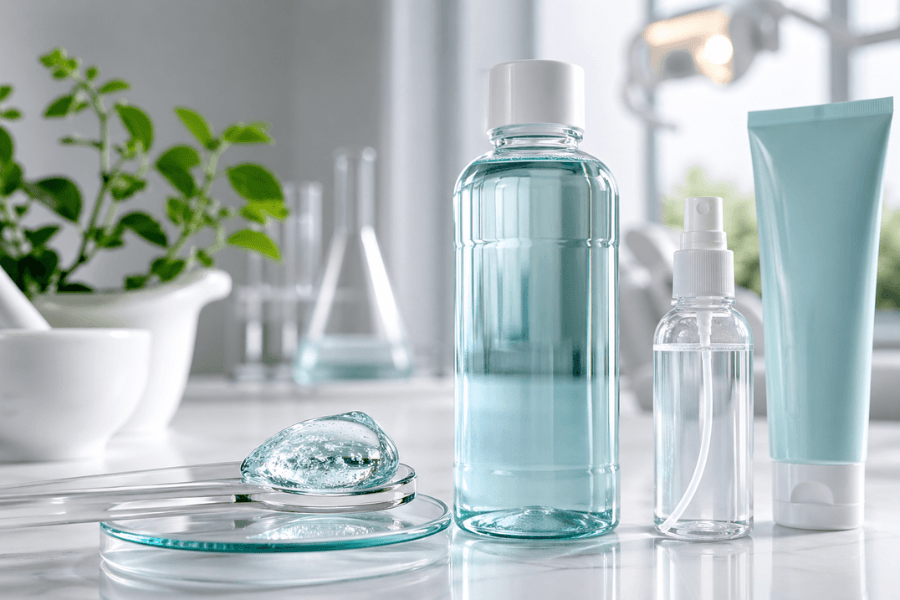
Gel, mouthwash, and other formats: why personalization matters
Artificial saliva can come in different forms, such as gel, spray, solution, or mouthwash. The choice depends on the clinical objective. Some patients need longer-lasting relief during the night, when dry mouth worsens and discomfort interferes with sleep. Others need support throughout the day, especially for speaking, working, eating, or using dentures more comfortably.
Gel tends to remain longer on the mucosa and may be interesting for nighttime use or for patients with more intense dryness. Mouthwashes and solutions, on the other hand, may help with lubrication and the sensation of comfort during the daily routine. In all cases, the choice should consider the cause of dry mouth, the presence of cavities, the condition of the gums, the oral mucosa, the use of dentures, dental sensitivity, and the patient’s systemic condition.
The central point is that there is no single ideal artificial saliva for everyone. There is the most appropriate product for that patient, at that moment, within a broader care plan.
Artificial saliva does not replace diagnosis
One of the greatest risks when the patient feels dry mouth is trying to solve everything alone with over-the-counter products, without investigating the cause. Artificial saliva may relieve and protect, but it does not replace diagnosis. If the dryness is persistent, if there are sores, burning, taste changes, difficulty swallowing, increased cavities, recurrent candidiasis, or discomfort with dentures, professional evaluation is essential.
At Clínica Debora Ayala, dry mouth is analyzed within a broad perspective: health history, recent medical treatments, medications in use, hormonal changes, saliva quality, and the condition of the teeth, gums, and mucosa. This evaluation makes it possible to identify risks and build a plan that may involve artificial saliva, salivary stimulation, habit changes, biofilm control, preventive resources, hygiene guidance, and periodic follow-up.
Technology and products help, but the precision of care begins with diagnosis.
How artificial saliva can restore confidence and well-being
Anyone who has never experienced intense dry mouth may imagine that it is just thirst. But for many patients, xerostomia changes life. Eating can become difficult. Dry foods become uncomfortable. Speaking for a long time becomes tiring. The mouth burns. Sleep worsens. The smile loses spontaneity. The patient starts to avoid social meals, meetings, long conversations, and even simple moments of the day.
When properly indicated, artificial saliva can restore part of this comfort. It helps lubricate, protect, and reduce the sensation of dryness, allowing the person to resume activities with greater safety. In fragile patients, cancer patients, or those with persistent conditions, this can represent a huge difference in quality of life.
More than a product, artificial saliva can be a bridge between science and the patient’s everyday life. It does not erase all the causes of the problem, but it can help restore dignity, peace of mind, and protection in a condition that is often underestimated.
Take care of your dry mouth with specialized guidance at Clínica Debora Ayala
Artificial saliva is an important tool, especially when the mouth has lost part of its natural defense capacity. But it needs to be part of a responsible, individualized, and safe care plan.
If you are undergoing cancer treatment, feel persistent dry mouth, notice burning, difficulty swallowing, changes in taste, an increase in cavities, or oral dryness during menopause, this is the time to seek an evaluation. At Clínica Debora Ayala, each case is analyzed with attention to oral health, medical history, and the patient’s quality of life, always using technical, safe, and evidence-based language.
Get in touch and schedule a personalized consultation. Let’s understand the cause of your dry mouth and discuss the artificial saliva options and complementary care measures that are most appropriate for your case.
Dr. Debora Ayala – CRO 41.974/SP
Sources:
American Dental Association. Xerostomia (Dry Mouth). Disponível em: https://www.ada.org/resources/ada-library/oral-health-topics/xerostomia. Acesso em: 20 abr. 2026.
National Institute of Dental and Craniofacial Research. Dry Mouth. Disponível em: https://www.nidcr.nih.gov/health-info/dry-mouth. Acesso em: 20 abr. 2026.
Agência FAPESP. Artificial saliva containing sugarcane protein helps protect the teeth of patients with head and neck cancer. Disponível em: https://agencia.fapesp.br/artificial-saliva-containing-sugarcane-protein-helps-protect-the-teeth-of-patients-with-head-and-neck-cancer/56882. Acesso em: 20 abr. 2026.
ScienceDaily. Artificial saliva made from sugarcane protein protects teeth from acid and decay. Disponível em: https://www.sciencedaily.com/releases/2026/04/260403224458.htm. Acesso em: 20 abr. 2026.
CNN Brasil. Saliva artificial ajuda a proteger dentes de pacientes com câncer de cabeça. Disponível em: https://www.cnnbrasil.com.br/saude/saliva-artificial-ajuda-a-proteger-dentes-de-pacientes-com-cancer-de-cabeca/. Acesso em: 20 abr. 2026.
The ASCO Post. Small Study Examines Potential of Artificial Saliva in Patients With Head and Neck Cancer. Disponível em: https://ascopost.com/news/january-2026/small-study-examines-potential-of-artificial-saliva-in-patients-with-head-and-neck-cancer/. Acesso em: 20 abr. 2026.
Jacob, L. E. et al. Xerostomia – A Comprehensive Review with a Focus on Mid-Life Health. Journal of Mid-life Health / PMC. Disponível em: https://pmc.ncbi.nlm.nih.gov/articles/PMC9583374/. Acesso em: 20 abr. 2026.
Kapourani, A. et al. A Review on Xerostomia and Its Various Management Strategies: The Role of Advanced Polymeric Materials in the Treatment Approaches. Polymers / PMC. Disponível em: https://pmc.ncbi.nlm.nih.gov/articles/PMC8912296/. Acesso em: 20 abr. 2026.
Shrivastava, S. et al. Menopause and Oral Health: Clinical Implications and Management Strategies. PMC. Disponível em: https://pmc.ncbi.nlm.nih.gov/articles/PMC11601932/. Acesso em: 20 abr. 2026.
García-Alfaro, P. et al. Xerostomia and oral health-related quality of life in peri- and postmenopausal women. Maturitas / ScienceDirect. Disponível em: https://www.sciencedirect.com/science/article/abs/pii/S0378512225000763. Acesso em: 20 abr. 2026.
Read Also
