

What makes a smile more harmonious?
A more harmonious smile is not necessarily the whitest, the most aligned, or the one with perfectly identical teeth. True harmony appears when different elements connect in a balanced way: color, shape, proportion, tooth position, gingival contour, lip movement, and facial characteristics.
That is why two patients should never receive exactly the same aesthetic treatment plan. Each person has a unique facial anatomy, expression, clinical history, and way of smiling. What enhances one face may not create the same effect on another. When dentistry ignores this individuality, the result may appear technically correct, but it loses naturalness.
At Clínica Debora Ayala, dental aesthetics is approached through a comprehensive understanding of the patient. The goal is not to create a standardized smile, but to understand which adjustments can enhance what is already there while preserving identity, health, and function.
Because a truly beautiful smile does not look as though it was copied from someone else. It looks as though it belongs to you.
Smile harmony is the result of balance
When we look at a smile, we do not see each element separately. The brain perceives the whole. The relationship between the teeth, gums, lips, and face creates an overall impression of balance or disharmony.
For this reason, there is no single detail responsible for making a smile beautiful. Bright teeth may lose their impact if their shape is not integrated with the face. Technically correct alignment may look artificial if all the teeth are excessively identical. A beautifully executed restoration may not achieve the expected result if the gingival margin is inflamed or irregular.
Harmony is created through the relationship between the different parts. Instead of asking only whether the teeth are white or aligned, it is necessary to observe whether the smile connects with the face, follows the movement of the lips, and respects that patient’s natural proportions.
Tooth color is only one part of the result
Color influences the perception of brightness and health, but it does not determine the beauty of the smile on its own. A natural tooth does not have a completely uniform color. It presents translucency, variations in brightness, depth, and subtle differences between different areas.
When the sole objective becomes achieving the most intense white possible, there is a risk of losing these characteristics and creating a result that is disconnected from the patient’s skin, lips, age, and facial expression.
A more harmonious smile does not need to be excessively white. It needs to have a shade that enhances the face and preserves the natural appearance of the teeth. In some cases, teeth whitening is enough to achieve this effect. In others, it is necessary to evaluate stains, old restorations, structural changes, or color differences that do not respond in the same way to whitening.
For this reason, the choice of shade should not follow a trend or an external standard. It needs to make sense within that particular smile.
Tooth shape and proportion change how the smile is perceived
The shape of the anterior teeth has a significant influence on aesthetics. Longer, more rounded, squarer, or more delicate teeth create different impressions, especially when considered in relation to the shape of the face and the outline of the lips.
However, there is no universally ideal tooth shape. Beauty does not depend on the rigid application of a mathematical formula. Studies on smile aesthetics show that different proportions may be considered attractive and that a relatively broad range of variations can be perceived as harmonious.
In practice, this means that treatment planning should not try to fit every patient into the same proportions. What matters most is evaluating the width and height of the teeth, the way they gradually appear across the smile, the position of the midline, and the relationship between the central incisors, lateral incisors, and canines.
Small natural differences are also part of a genuine smile. Harmony does not require absolute symmetry. It requires coherence.
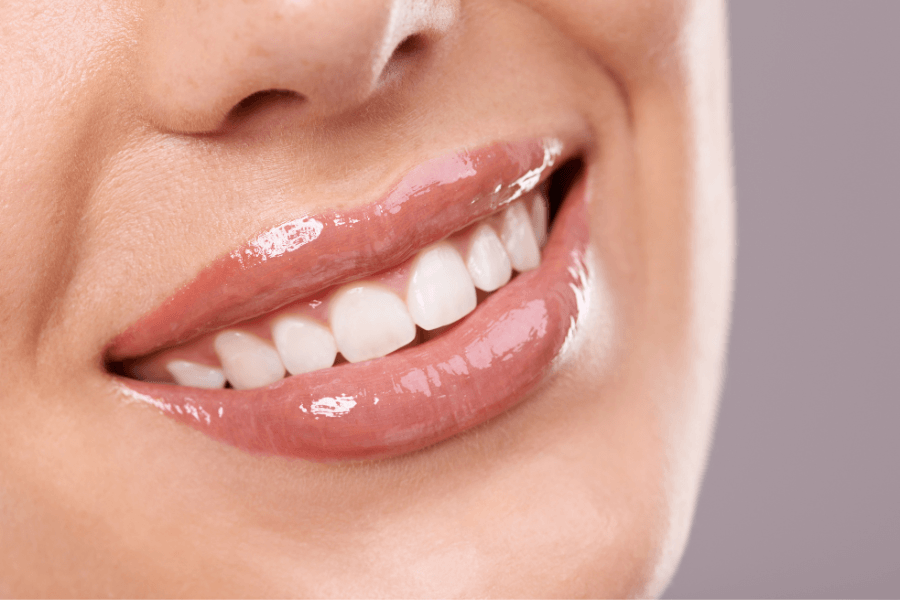
Alignment does not mean turning every tooth into an identical piece
Misaligned, rotated, or spaced teeth can interfere with smile harmony, but correcting these changes does not mean eliminating all dental personality.
Alignment should improve function, hygiene, and aesthetics while respecting the anatomy of the teeth and the patient’s bone structure. In some cases, orthodontic treatment is the most appropriate approach. In others, small restorative adjustments may be considered. There are also situations in which combining different treatments offers a more conservative and predictable result.
The mistake lies in believing that aesthetics means making every tooth the same size, shape, and appearance. When this happens, the smile may lose depth, movement, and naturalness.
Careful planning maintains a balanced visual sequence without erasing the patient’s individual characteristics.
The gums are also part of smile aesthetics
It is not possible to analyze the beauty of the teeth without observing the gums that surround them. The gingival contour works like a frame, influencing the apparent height of the teeth, symmetry, and continuity of the smile.
Inflamed gums, bleeding, recession, irregularities, or excessive gingival display can significantly change aesthetic perception. However, these situations should not be evaluated based only on appearance. Each may have different causes and require specific approaches.
Excessive gingival display, for example, may be related to tooth size, gingival position, lip movement, maxillary position, or a combination of factors. Before recommending any procedure, it is necessary to understand the origin of the change.
The same applies to gingival recession and dark spaces between the teeth. Aesthetic correction only makes sense when it respects periodontal health and tissue stability.
At Clínica Debora Ayala, the gums are not treated as a minor detail. They are part of the diagnosis and the overall planning of the smile.
The lips and smile movement need to be considered
A smile is not a still image. It changes during speech, laughter, and different facial expressions. For this reason, an evaluation based only on a frontal photograph may be insufficient.
Lip position, smile curvature, the amount of tooth displayed, buccal corridors, and the relationship between the edges of the upper teeth and the lower lip all influence the perception of harmony. These elements need to be observed in motion because the real smile happens dynamically.
The curve formed by the edges of the upper teeth, for example, often appears more pleasing when it follows the contour of the lower lip in a balanced way. Once again, however, this relationship should not be turned into a rigid rule. It must be interpreted within each person’s anatomy and expression.
It is through this dynamic assessment that we understand whether a smile appears light, tense, broad, restrained, or disconnected from the rest of the face.
The face guides aesthetic planning
The smile occupies a central area of the face and, for that reason, cannot be planned in isolation. Facial width, face shape, lip position, the midline, the height of the lower facial third, and the relationship between the mouth and the dental arch all help define what will be perceived as balanced.
A wider dental arch is not necessarily better for everyone. Likewise, larger or longer teeth do not automatically produce a more beautiful smile. Every change needs to be assessed in relation to the facial structure that will receive it.
Harmony appears when there is continuity between the smile and the face. The patient should not look at the result and notice only the teeth. They should recognize their own expression, enhanced without the treatment taking the place of their identity.
This is one of the reasons individualized planning is so important. It prevents aesthetic trends from being applied indiscriminately and protects the patient from artificial or disproportionate results.
Naturalness does not mean a lack of planning
There is a mistaken idea that a natural result happens when almost nothing is analyzed or when treatment is performed intuitively. In reality, achieving naturalness requires even more careful planning.
It is necessary to study color, texture, brightness, translucency, dental proportions, gingival position, alignment, bite function, and integration with the lips and face. Resources such as clinical photography, intraoral scanning, and digital planning can help visualize these relationships before treatment begins.
In some cases, simulations can also be performed so that the patient understands the proposal and takes part in the decisions. Technology, however, does not replace clinical judgment. It provides information that allows diagnosis and planning to be more precise.
Naturalness emerges when technique, science, and aesthetic sensitivity work together.
A harmonious smile also needs to function well
Aesthetics cannot be separated from function. Beautiful teeth need to support chewing, speech, and the proper distribution of forces. When treatment planning considers only the frontal image without evaluating the bite, mandibular movements, bruxism, or wear patterns, the result may lose stability over time.
Veneers, restorations, alignment, and changes in tooth shape need to respect the contacts between the teeth. Otherwise, fractures, wear, muscle discomfort, or the need for retreatment may occur.
For this reason, a more harmonious smile is not only one that looks balanced. It is also one that functions in a way that is compatible with the patient’s body.
At Clínica Debora Ayala, aesthetics and function go hand in hand. The result needs to be beautiful in the present, but also safe and predictable enough to accompany the patient over the years.
Dental aesthetics is not standardization
Social media has increased access to aesthetic references, but it has also strengthened the idea that there is only one model of a perfect smile. Extremely white, highly aligned teeth with similar shapes have come to be presented as a universal goal.
But dental aesthetics should not erase differences. It should enhance identity.
Every smile carries characteristics related to the patient’s age, anatomy, expression, and history. Some asymmetries are natural and even important for preserving authenticity. The role of treatment is not to eliminate everything that makes a person unique, but to find a balance between what can be improved and what should be preserved.
When planning follows this logic, the result does not look like an imposed transformation. It looks like a lighter, healthier, and more confident version of the patient.

What may be necessary to make the smile more harmonious?
There is no single answer because the indication depends on the diagnosis. For some patients, professional cleaning and well-conducted whitening may already produce the desired change. For others, it may be necessary to correct alignment, replace old restorations, treat the gums, restore worn teeth, or reorganize proportions.
There are also cases in which no immediate aesthetic procedure is recommended. Before thinking about appearance, it may be necessary to control inflammation, treat cavities, investigate bruxism, or correct functional changes.
The best strategy is not the one that combines the greatest number of procedures. It is the one that delivers the necessary result while preserving structure, respecting biology, and remaining consistent with the patient’s goals.
That is why evaluation comes before technique. It is during this stage that we define what truly needs to be done and, just as importantly, what does not need to be changed.
Discover the best path toward a more harmonious smile
A more harmonious smile does not come from excess or from trying to copy a standard. It comes from understanding how the teeth, gums, lips, function, and face connect in each patient.
At Clínica Debora Ayala, every treatment plan is developed individually, respecting dental structure, tissue health, facial identity, and the expectations of those seeking treatment. The goal is to enhance your essence and find the balance that allows your smile to appear with greater naturalness, lightness, and confidence.
Get in touch and schedule your personalized evaluation with Dr. Debora Ayala. Together, we will understand what your smile truly needs and define the safest, most conservative, and most coherent path toward a beautiful result that is genuinely yours.
Dr. Debora Ayala – CRO 41.974/SP
Sources:
Jouhar, R. et al. Smile aesthetics in Pakistani population: dentist preferences and perceptions of anterior teeth proportion and harmony. BMC Oral Health, 2024. Available at: https://pubmed.ncbi.nlm.nih.gov/38553673/. Accessed on: Jul. 24, 2026.
Niknam, O.; Hafshejani, S. Y.; Rakhshan, V. Attractive combinations of female gingival displays, buccal corridor sizes, and facial heights according to orthodontists, dentists, and laypeople. Head & Face Medicine, 2024. Available at: https://pubmed.ncbi.nlm.nih.gov/38459597/. Accessed on: Jul. 24, 2026.
Evaluation of aesthetics of posed smiles based on smile-related characteristics. Available at: https://pmc.ncbi.nlm.nih.gov/articles/PMC11928382/. Accessed on: Jul. 24, 2026.
Effects of transverse relationships between maxillary arch, mouth, and face on smile esthetics. Available at: https://pmc.ncbi.nlm.nih.gov/articles/PMC8603960/. Accessed on: Jul. 24, 2026.
Kim, S.; Cho, Y. Pink esthetic treatment of gingival recession, black triangle, and gummy smile: a narrative review. Available at: https://pmc.ncbi.nlm.nih.gov/articles/PMC12271026/. Accessed on: Jul. 24, 2026.
Facial, dental, periodontal, and tomographic characteristics of the etiology of excessive gingival display: a cross-sectional clinical study. Available at: https://pmc.ncbi.nlm.nih.gov/articles/PMC11729246/. Accessed on: Jul. 24, 2026.
Leveraging Digital Smile Design Technology in Esthetic Restorative Dentistry. Available at: https://pubmed.ncbi.nlm.nih.gov/39561341/. Accessed on: Jul. 24, 2026.
Recent advances in cosmetic dentistry: A review. Available at: https://pmc.ncbi.nlm.nih.gov/articles/PMC12449501/. Accessed on: Jul. 24, 2026.
Read Also
