
Tooth sensitivity is not normal
Tooth sensitivity often begins quietly. At first, it appears as occasional discomfort when drinking something cold, consuming acidic foods, or even during brushing.
Because it seems minor, many people get used to the pain and continue their routine without investigating what is behind the symptom.
But in clinical practice, this adaptation deserves attention. Sensitivity should not be treated as something common or expected. It is a sign that the tooth’s protective structure, the gums, or even the dynamics of your oral health may be asking for care.
More than simply relieving the pain momentarily, the central point is understanding the origin of the problem. When the cause is identified early, it is often possible to intervene more conservatively, protect the enamel, control dentin exposure, and prevent the discomfort from progressing into more complex conditions.
That is why, at Clínica Debora Ayala, sensitivity is seen as an important warning from the body, not as a detail to be ignored.
When pain is a warning sign that something needs to be evaluated
Tooth sensitivity is often treated as something far too common. Many people get used to feeling pain when drinking something cold, eating acidic foods, breathing in cold air, or even during brushing, and begin to see it as part of everyday life. But from a clinical perspective, this adaptation is a mistake.
Dentin hypersensitivity is a short, sharp pain triggered by external stimuli in areas of exposed dentin, and it cannot be explained by another specific dental condition. In other words, it is a real symptom, with a known mechanism, and it deserves investigation.
In practice, this pain usually appears when enamel loses part of its protective function or when the gums recede and expose more vulnerable root surfaces. There are resources that can help control the pain, but proper management depends on recognizing the cause of dentin exposure rather than simply masking the symptom. This matters because tooth sensitivity may be related to erosive wear, abrasion, gingival recession, traumatic brushing, whitening, periodontal disease, non-carious cervical lesions, and other factors that completely change the clinical approach.
Why pain appears when dentin becomes exposed
Enamel is the mineralized layer that protects the crown of the tooth. When it wears down or loses integrity, the underlying dentin may become exposed. Dentin contains microscopic tubules that communicate with the dental pulp, and this is exactly where the classic explanation for the pain comes in: the external stimulus changes the movement of fluid inside these tubules, which triggers a pain response.
That is why pain can arise from apparently simple everyday situations. A sip of cold water, an acidic food, more intense brushing, or even a current of air may be enough to trigger the symptom when dentin is exposed. The problem is not the stimulus itself, but the loss of the protective barrier that should isolate the internal structure of the tooth.
For this reason, sensitivity is neither an exaggeration nor a baseless response. It is a physiological sign that something is compromising the natural protection of the tooth.
Enamel wear: a silent beginning
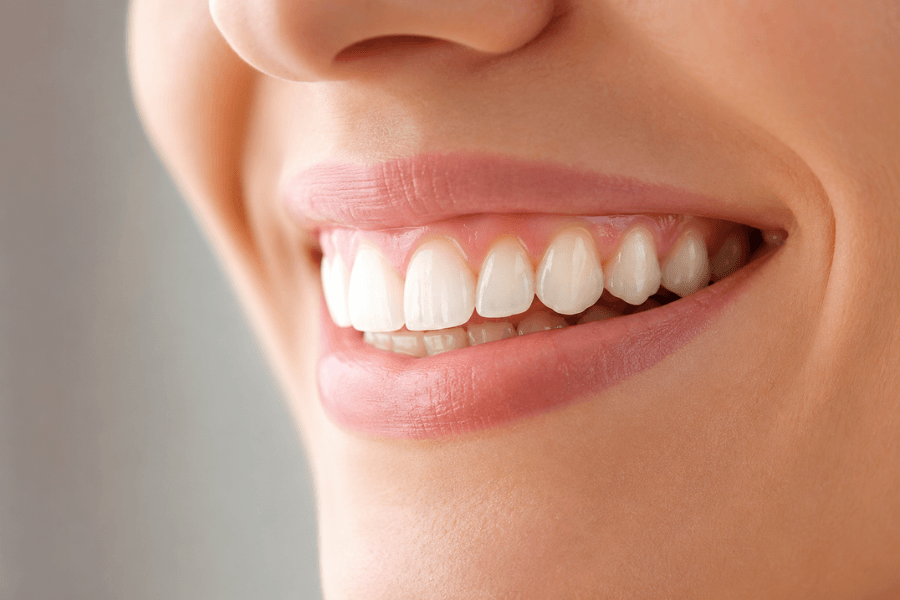
In many cases, tooth sensitivity begins with enamel wear. And this wear is not always noticed early. It may occur through chemical erosion, mechanical abrasion, attrition related to tooth-to-tooth contact, or a combination of these factors.
Acidic drinks, soft drinks, gastroesophageal reflux, recurrent vomiting, brushing with excessive force, improper use of the toothbrush, and highly abrasive toothpastes may all contribute to this process. In more advanced cases, this structural loss may progress to exposed dentin, sensitivity, and even greater compromise of dental anatomy.
This helps explain why relieving the pain without evaluating habits, diet, hygiene technique, and enamel quality usually brings only temporary improvement. Without correcting the cause, the discomfort tends to return.
Gingival recession also changes the picture completely
Another very frequent pathway to tooth sensitivity is gingival recession. When the gingival margin migrates toward the root, part of that region becomes exposed. And the root does not have enamel as protection. It presents cementum and root dentin, structures much more susceptible to pain when exposed to the oral environment.
Gingival recession may be associated with different factors, such as individual anatomy, brushing trauma, gingival inflammation, periodontitis, tooth movement, and other clinical aspects. When this happens, sensitivity may be one of the first symptoms noticed by the patient.
In other words, when the gums recede, pain from cold, acidic foods, or brushing should not be minimized. It may be the initial sign of a condition that deserves careful evaluation.
When sensitivity may indicate more than simple discomfort
Not every pain triggered by cold is automatically dentin hypersensitivity. And this point is crucial. Before confirming this diagnosis, the dentist must rule out other possible causes, such as cavities, cracked teeth, leaking restorations, pulpal inflammation, fracture, post-whitening pain, cervical lesions, or even referred pain from another tooth.
This explains why the best approach is never to assume on your own that “it’s just sensitivity.” When a patient self-medicates with desensitizing products without evaluation, they may reduce the pain for a while, but they also risk delaying the diagnosis of a condition that required a different approach.
In oral health, a controlled symptom is not the same as a resolved cause. And at Clínica Debora Ayala, this reasoning is central: the focus is not on silencing the body’s warning, but on understanding what it is trying to communicate.
How dentistry evaluates tooth sensitivity
The evaluation of tooth sensitivity begins with a careful history. It is important to understand when the pain appears, which teeth are involved, which stimuli trigger it, and for how long it has been happening. It is also necessary to observe diet, hygiene habits, whitening history, bruxism, reflux, gum disease, and previous treatments.
During the clinical examination, the dentist evaluates enamel wear, the presence of exposed dentin, gingival recession, cervical lesions, signs of abrasion, cavities, cracks, and the integrity of restorations. This step is essential because it guides treatment.
If the predominant cause is acidic erosion, the strategy must involve dietary control and protection of the tooth surface. If the problem is more related to gingival recession, the periodontal approach may be decisive. If there is a non-carious cervical lesion, the indication may include professional desensitization, sealing, specific agents, or even restoration, depending on the case.
What makes the difference is not merely knowing that sensitivity exists. It is understanding why it is happening.

Treating the origin is worth more than just relieving the pain
This is perhaps the most important point of the topic: tooth sensitivity should not be treated only as a discomfort to be suppressed. Desensitizing products may be useful and, in many cases, are part of the treatment plan. But this does not eliminate the need to investigate the origin of dentin exposure and correct risk factors.
In practice, this means that treatment may involve hygiene guidance, adjustment of brushing technique, changing the toothbrush and toothpaste, reducing acid consumption, investigating reflux, controlling bruxism, in-office desensitization, periodontal therapy, restoration of cervical lesions, or a combination of these approaches.
What defines excellence is not just the pain disappearing for a few days, but the patient regaining comfort more consistently, with less risk of progression of wear or new complications.
Sensitivity is a warning, not a detail
There is both a clinical and an educational aspect to this topic. Many patients normalize the pain because it is intermittent. Since it is not constant, they think it is not worth investigating. But it is precisely this initial phase that offers the best opportunities for conservative intervention.
Before the wear progresses, before the recession increases, and before the structure loses even more protection, there is a window in which diagnosis and a change in approach can preserve more tissue and prevent more complex treatments in the future.
At Clínica Debora Ayala, this kind of symptom is seen as a sign that deserves attention, not as something trivial. When a tooth hurts with cold, acid, or brushing, the goal is not just to recommend a toothpaste and end the conversation. It is to understand why. Because the body usually warns before it worsens.
Take care of tooth sensitivity with precise evaluation
If you feel tooth sensitivity when drinking something cold, eating acidic fruits, breathing in cold air, or brushing your teeth, this is the moment to investigate. The pain may seem minor now, but it may be signaling enamel wear, gingival recession, exposed dentin, or other changes that deserve clinical attention.
At Clínica Debora Ayala, each case is evaluated individually, with a focus on precise diagnosis, understanding of the cause, and definition of the most appropriate strategy to protect your smile with safety and predictability. The goal is not only to relieve the pain of the moment, but to treat the origin of the problem and preserve oral health in the long term.
Get in touch and schedule your personalized consultation with Dr. Debora Ayala. Let us understand what your sensitivity is trying to say and define, with technical rigor and clinical insight, the best path to restore comfort and protection to your smile.
Dr. Debora Ayala – CRO 41.974/SP
Sources:
American Dental Association. Toothpastes. Available at: https://www.ada.org/resources/ada-library/oral-health-topics/toothpastes. Accessed on: Jun. 17, 2026.
American Dental Association. Dental Erosion. Available at: https://www.ada.org/resources/ada-library/oral-health-topics/dental-erosion. Accessed on: Jun. 17, 2026.
Kaur, A. et al. Dentin hypersensitivity, an enigma revisited: Mechanisms, diagnosis and management. Available at: https://pmc.ncbi.nlm.nih.gov/articles/PMC13086383/. Accessed on: Jun. 17, 2026.
Martins, J. M. et al. Effect of different material protocols on the control of dentin hypersensitivity. Available at: https://pmc.ncbi.nlm.nih.gov/articles/PMC12948845/. Accessed on: Jun. 17, 2026.
Kopycka-Kedzierawski, D. T. et al. Management of Dentin Hypersensitivity by National Dental Practice-Based Research Network Dentists. Available at: https://pmc.ncbi.nlm.nih.gov/articles/PMC5237301/. Accessed on: Jun. 17, 2026.
Cunha-Cruz, J. et al. The prevalence of dentin hypersensitivity in general dental practices. Available at: https://pubmed.ncbi.nlm.nih.gov/23449905/. Accessed on: Jun. 17, 2026.
Cortellini, P. et al. Mucogingival conditions in the natural dentition. Available at: https://pubmed.ncbi.nlm.nih.gov/29926948/. Accessed on: Jun. 17, 2026.
Heasman, P. A. et al. Gingival recession and root caries in the ageing population. European Federation of Periodontology. Available at: https://www.efp.org/fileadmin/uploads/efp/Documents/Campaigns/Perio_and_Caries/Scienific_papers/gingival-recession-root.pdf. Accessed on: Jun. 17, 2026.
Naghsh, N. et al. Evaluation of Three Methods for the Treatment of Dentin Hypersensitivity. Available at: https://pmc.ncbi.nlm.nih.gov/articles/PMC11563163/. Accessed on: Jun. 17, 2026.
Javed, F. et al. Effectiveness of lasers in managing dentine hypersensitivity. Available at: https://pmc.ncbi.nlm.nih.gov/articles/PMC12552325/. Accessed on: Jun. 17, 2026.
Read Also
