
PRF in dentistry: When your own body becomes an ally in healing
In many dental surgical procedures, patients usually think only about the surgery itself. But the quality of recovery is a decisive part of treatment. Pain, swelling, risk of infection, wound closure speed, and the ability of tissues to regenerate directly influence postoperative comfort and predictability. It is exactly at this point that PRF in dentistry has been gaining prominence: because it is an autologous concentrate obtained from the patient’s own blood, rich in fibrin, platelets, leukocytes, and growth factors, used as a biological support to promote healing and regeneration.
In clinical practice, PRF represents an important shift in logic. Instead of relying only on external materials to support recovery, dentistry now makes organized and enhanced use of resources that the body itself naturally produces to repair tissues. For this reason, more than a complementary technique, platelet-rich fibrin has become a valuable resource in oral surgeries, extractions, grafts, and regenerative procedures, especially when the goal is a more biological and predictable postoperative course.
What is PRF and why does it attract so much attention in dentistry?
PRF in dentistry stands for platelet-rich fibrin, although technically the focus is less on the “platelet-rich plasma” idea and more on the fibrin matrix formed after blood centrifugation. Unlike PRP, which usually requires additives in some protocols, PRF is considered a second-generation blood concentrate, obtained in a simpler way and without anticoagulants, forming a fibrin network that traps platelets, leukocytes, and several bioactive molecules released progressively at the treated site.
This detail matters because the fibrin matrix does not act only as a “filler.” It works as a temporary biological structure that helps organize tissue repair. Within it, growth factors are released over time, favoring angiogenesis, cell migration, and healing response. In addition, the presence of leukocytes contributes to the local immune microenvironment, which helps explain why so many studies associate PRF with improved healing and reduced postoperative complications.
How is PRF obtained?
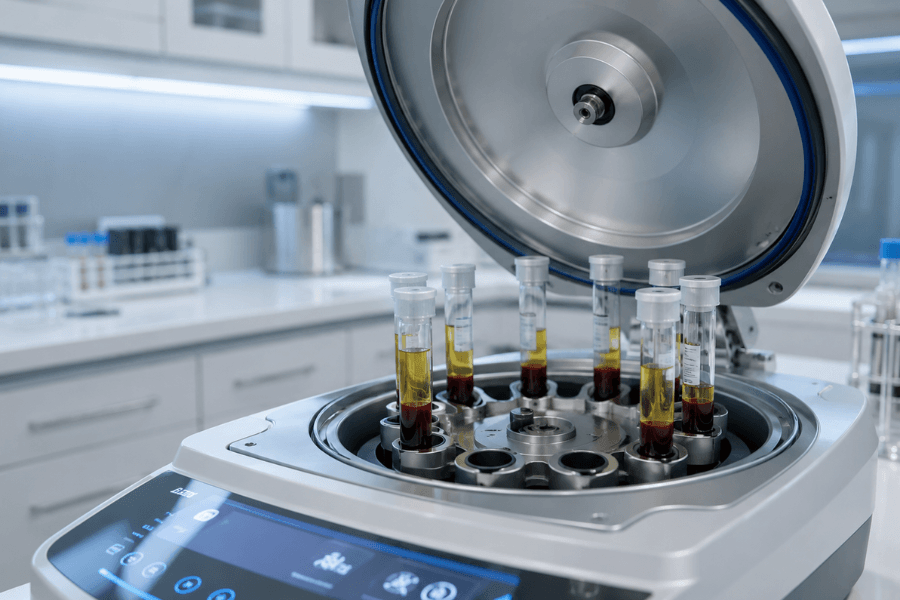
From the patient’s point of view, the process is usually simple. A small amount of venous blood is collected and immediately centrifuged according to a specific protocol. From this centrifugation, a fraction rich in fibrin and cellular components useful for tissue repair is obtained. Depending on the technique and the clinical goal, this material can be transformed into a membrane, plug, or injectable form, such as i-PRF. Recent studies highlight that variations in the centrifugation protocol influence the final composition of the material and, for this reason, technical standardization is important to achieve consistent results.
Although the simplified explanation often says that PRF “tells the body to heal now,” what actually happens is a local modulation of the repair process. Fibrin functions as a matrix, while the growth factors and cells present help the organism respond in a more organized way. It is a biologically sophisticated mechanism, but based on something very intuitive: using the patient’s own regenerative potential in favor of surgery.
PRF in dentistry and postsurgical healing
One of the reasons why PRF in dentistry attracts so much interest is its effect on healing after extractions and oral surgeries. Recent systematic reviews indicate that the use of PRF may favor soft tissue healing, reduce postoperative pain in some contexts, and contribute to better socket repair after tooth extractions.
In third molars, for example, a 2024 meta-analysis concluded that local PRF application after lower wisdom tooth extraction is a viable method for reducing some postoperative complications, especially with regard to pain and clinical recovery in certain scenarios.
In post-extraction sockets, the most recent literature has also associated PRF with improved hard and soft tissue repair and, in some studies, with more favorable preservation of local bone dimensions. This does not mean that PRF replaces all biomaterials or all regeneration techniques, but it reinforces its usefulness as a highly valuable biological adjunct in well-indicated cases.
Bone regeneration, soft tissues, and result stability
In contemporary dentistry, it is not enough simply to close the wound: it is necessary to think about regeneration and stability. Platelet-rich fibrin has also been studied in association with grafts and biomaterials for guided bone regeneration, socket preservation, and peri-implant procedures. An umbrella review published in 2025 concluded that PRF and PRP have the potential to improve healing and regeneration in different dental applications, although the magnitude of the effect varies according to the procedure and the methodological quality of the studies.
In implant dentistry, recent systematic reviews suggest that PRF shows promising results for peri-implant healing and stability, especially as a complementary resource. In bone regeneration, it also appears in combination with particulate biomaterials to improve clinical handling and the biological environment of the graft, as in the so-called “sticky bone” in certain protocols.
What this shows in practice is that PRF does not need to be seen only as a “postoperative adjunct.” In many cases, it is part of the regeneration strategy, helping create more favorable biological conditions for bone and tissue repair. Even so, the final result always depends on the diagnosis, the type of surgery, the patient’s systemic condition, the technique employed, and the correct indication.
The role of leukocytes and the idea of local defense
One point that draws attention in discussions about PRF is the presence of leukocytes, the body’s defense cells. The literature describes L-PRF as a concentrate that includes leukocytes, in addition to platelets and fibrin, and this composition has been associated with benefits in the healing microenvironment and, potentially, in local infection control in healing wounds.
It is important to communicate this precisely. Saying that PRF “eliminates the risk of infection” would be an exaggeration. What the evidence suggests is that it can strengthen the local biological environment and contribute to a more favorable repair process, which helps recovery and may reduce some complications. The local immune effect is part of the logic of the material, but it does not replace asepsis, proper surgical technique, correct planning, and postoperative follow-up.
PRF is not a magical solution and is not indicated for every case
Like any biomedical resource, PRF in dentistry has indications, limits, and technical variables. The literature is promising, but still heterogeneous. There are reviews showing clear benefits in some outcomes and less consistent results in others, often due to differences between centrifugation protocols, surgical technique, type of procedure, and study design.
This means that PRF should not be presented as a universal promise of “exponential healing” in any situation. What it offers is a relevant autologous biological support that can be extremely useful when well indicated and properly executed. Patients with specific systemic conditions, hematological alterations, or particular surgical contexts need individualized assessment. In healthcare, what truly transforms is not the trend of the moment, but the integration between diagnosis, indication, and technique.
Why PRF aligns with the philosophy of Clínica Debora Ayala
At Clínica Debora Ayala, dentistry is not approached as the isolated execution of procedures, but as an integration of diagnosis, technique, and biology. The interest in PRF in dentistry makes perfect sense for that reason: it is in line with a treatment philosophy that respects the patient’s body and seeks to promote more predictable results through scientifically studied resources.
When a patient is about to undergo dental surgery, the question should not be only “what will the procedure be like?” but also “how will this body heal, with what quality, and with what level of comfort?” In a clinic that values predictability, technology, and an integral view of the patient, PRF emerges as a coherent resource: autologous, biological, technically refined, and aligned with a more careful recovery process.
More than simply speeding up recovery in a simplistic way, PRF’s role is to improve the repair environment. And that difference is very important. It is not about shortcuts. It is about using science to support the body’s natural regenerative capacity.
When to discuss PRF in dentistry
If you are about to undergo a tooth extraction, periodontal surgery, implant placement, bone graft, or another oral surgical procedure, it is worth discussing the possibility of using PRF in dentistry as part of your surgical plan. This conversation is even more important for patients who value a more comfortable postoperative course, a more biological approach, and a recovery process carried out with greater attention to the tissues.
The use of PRF does not replace the need for good planning, nor does it turn every surgery into a simple procedure. But it may be an important differentiator in well-selected cases, especially when the goal is to favor healing, regeneration, and long-term stability of the result.
Take care of your recovery with more biology, science, and precision
PRF in dentistry shows how science has advanced by learning to enhance mechanisms that the body itself already knows. Healing does not depend only on wound closure, but on the quality of the biological response that takes place afterward. And when that response can be supported by the patient’s own blood, dentistry gains a highly valuable resource.
At Clínica Debora Ayala, each surgery is planned in an individualized way, with attention to the patient’s health as a whole, precise diagnosis, and the quality of recovery. If you are going to undergo a dental surgical procedure or would like to better understand how platelet-rich fibrin can help in your postoperative period, get in touch and schedule a personalized consultation.
We will assess your case in depth and discuss the most appropriate options to support your regeneration, your healing, and your peace of mind at every stage of treatment.
Dr. Debora Ayala – CRO 41.974/SP
Sources:
Fioravanti, C. et al. Autologous blood preparations rich in platelets, fibrin and growth factors. Transfusion and Apheresis Science / PMC. Disponível em: https://pmc.ncbi.nlm.nih.gov/articles/PMC5159895/. Acesso em: 12 maio 2026.
Roy, S. et al. Platelet Rich Fibrin Matrix Improves Wound Angiogenesis via Inducing Endothelial Cell Proliferation. Wound Repair and Regeneration / PMC. Disponível em: https://pmc.ncbi.nlm.nih.gov/articles/PMC3623798/. Acesso em: 12 maio 2026.
Napit, I. B. et al. Leucocyte and Platelets Rich Fibrin (L-PRF) and wound healing in dentistry. PMC. Disponível em: https://pmc.ncbi.nlm.nih.gov/articles/PMC10729115/. Acesso em: 12 maio 2026.
Ye, L. et al. Effect of platelet-rich fibrin on the recovery after third molar extraction: a meta-analysis. PubMed. Disponível em: https://pubmed.ncbi.nlm.nih.gov/39003218/. Acesso em: 12 maio 2026.
Yuan, Y. et al. Effects of platelet-rich fibrin on post-extraction wound healing: a systematic review and meta-analysis. PMC. Disponível em: https://pmc.ncbi.nlm.nih.gov/articles/PMC10830918/. Acesso em: 12 maio 2026.
Hajibagheri, P. et al. The efficacy of platelet-rich fibrin (PRF) in post-extraction hard and soft tissue healing. PMC. Disponível em: https://pmc.ncbi.nlm.nih.gov/articles/PMC12126912/. Acesso em: 12 maio 2026.
Wang, X. et al. Platelet-rich fibrin on dental extraction and ridge preservation. PubMed. Disponível em: https://pubmed.ncbi.nlm.nih.gov/39396147/. Acesso em: 12 maio 2026.
Acerra, A. et al. PRF and PRP in Dentistry: An Umbrella Review. PMC. Disponível em: https://pmc.ncbi.nlm.nih.gov/articles/PMC12072518/. Acesso em: 12 maio 2026.
Giammarinaro, E. et al. Does platelet-rich fibrin enhance the outcomes of peri-implant procedures? PMC. Disponível em: https://pmc.ncbi.nlm.nih.gov/articles/PMC12016366/. Acesso em: 12 maio 2026.
Soares, L. F. F. et al. Platelet-Rich Fibrin Low-Speed Centrifugation Protocols and biomaterial associations. PMC. Disponível em: https://pmc.ncbi.nlm.nih.gov/articles/PMC12641583/. Acesso em: 12 maio 2026.
Read Also
