
Natural-looking teeth whitening: how to brighten your smile without overdoing it
A brighter smile can change the way a patient sees themselves, but that does not mean pursuing an artificially white result disconnected from their own identity. In high-level dentistry, teeth whitening is not treated as an attempt to standardize smiles, but as a way to restore brightness, lightness, and harmony in a safe and personalized way.
Before any procedure, it is essential to understand that the ideal tooth shade is not the same for everyone. It depends on dental structure, gingival health, the presence of restorations, the degree of sensitivity, and also on how that smile integrates with the patient’s face and expression. That is why a well-indicated whitening treatment begins long before the whitening agent is applied. It begins with clinical evaluation, diagnosis, and the definition of a strategy that respects the individuality of each case.
At Clínica Debora Ayala, whitening a smile is not about pushing the color to extremes. It is about achieving a beautiful, balanced, and natural result with safety and predictability. Because a truly bright smile does not need to stand out through excess. It needs to suit you.
Brightening your smile is not about overdoing it. It is about revealing what suits you
When people talk about teeth whitening, many still associate the procedure with an artificial, overly uniform white that feels far removed from the natural expression of the face. But that is not the purpose of a well-conducted treatment. Whitening the smile does not mean erasing each patient’s individuality. It means enhancing the natural shade of the teeth, restoring brightness to the smile, and building a harmonious result with the face, the gums, and that person’s real aesthetic identity.
At Clínica Debora Ayala, teeth whitening is not treated as a standard procedure repeated the same way for everyone. It is planned based on a careful clinical evaluation, because a beautiful smile does not depend only on the final tooth shade. It depends on balance, health, proportion, and a result that makes sense for the person who will be smiling.
That is why a well-indicated whitening treatment does not seek excess. It seeks naturalness. And in high-level dentistry, naturalness is never improvised. It is planned.
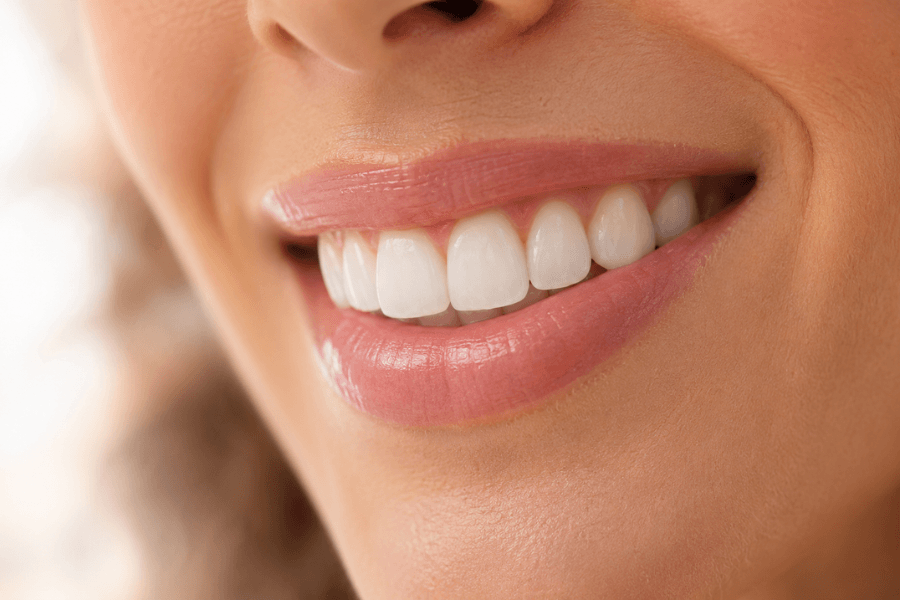
Teeth whitening is not about making the smile artificially white
There is an important difference between whitening and stripping away character. A beautiful smile is not necessarily the whitest one possible. In fact, when whitening is carried out without criteria, the result may lose aesthetic depth and drift away from the healthy and elegant appearance the patient is seeking.
Each person has a different dental anatomy, enamel thickness, baseline tooth shade, and a different relationship between teeth, skin, lips, and facial expression. What works for one patient may not work for another. A truly well-indicated whitening treatment respects exactly these differences. It does not try to turn every smile into the same standard. It seeks to enhance what is already beautiful in that smile within its own identity.
This is a central point: teeth whitening should not be confused with aesthetic exaggeration. When well planned, it brightens the smile without taking away its naturalness. And that balance is often the true hallmark of results that age well and remain pleasing over time.
Professional evaluation comes before the procedure
Before any whitening treatment, the most important thing is to understand whether it is truly indicated for that case. This is a step that is often underestimated, but it makes all the difference in the outcome and safety of the treatment.
During the clinical evaluation, we assess gingival health, the presence of gingival recession, areas of exposed dentin, old restorations, enamel lesions, cracks, pre-existing sensitivity, and the current shade pattern. We also evaluate the patient’s habits, history of discomfort with desensitizing products, diet, pigment intake, and expectations regarding the result.
This is essential because not every discoloration responds in the same way to whitening. There are extrinsic stains related to coffee, wine, tobacco, and food pigments. There are intrinsic changes related to dental structure, aging, trauma, medications, or previous treatments. There are also cases in which part of the issue lies less in the tooth color itself and more in texture, brightness, shape, or the contrast with existing restorations and prosthetic work.
It is precisely this clinical reading that prevents frustration. Instead of promising a generic result, professional evaluation defines the most coherent path to achieve a beautiful, natural, and safe smile.
Sensitivity and whitening: when technical care makes the difference
One of the topics that raises the most questions regarding teeth whitening is sensitivity. And that concern is valid. Some patients already present sensitivity even before the procedure, while others develop temporary discomfort during or shortly after treatment.
That is why, at Clínica Debora Ayala, whitening is never done automatically. Sensitivity is part of the prior analysis and directly influences the choice of technique, the concentration of the whitening agent, the contact time, and the need for complementary protective protocols.
When the patient already has gingival recession, enamel wear, or exposed dentin, the level of care needs to be even greater. In these cases, insisting on whitening without correctly assessing the condition of the tissues can compromise comfort and make the process more aggressive than it should be. The goal is never only to change the color. It is to do so while preserving the integrity of the enamel, gingival health, and the patient’s experience throughout the treatment.
Excellence in dentistry understands that the best result is not only the one that appears in the photo. It is the one that also respects the patient’s comfort throughout the process.
Not every smile needs the same type of whitening
Talking about teeth whitening as if there were a single formula for every patient is a mistake. There are different possible protocols, and the choice depends on the clinical condition, the aesthetic objective, and each person’s biological response.
In some cases, supervised at-home whitening makes more sense. In others, in-office treatment may be more appropriate. There are also situations in which the best strategy is to combine approaches, always with professional supervision and strict control of the patient’s response.
More important than the technique itself is the correct indication. The treatment needs to consider the biological pace of the smile and the predictability of the result. Whitening too much, too quickly, or without respecting the clinical context may seem attractive at first, but it is rarely the best path when the goal is to maintain naturalness, safety, and harmony.
Beautiful whitening is the kind that suits the patient
There is a mistaken idea that whitening is successful only when it reaches the lightest possible shade. In reality, a successful result is one that integrates with the patient’s face without looking forced. The smile needs to work with the skin, the lips, the age, the gingival aesthetics, and the way that person expresses themselves.
An excessively white smile may draw attention, but it does not always convey health, naturalness, or sophistication. On the other hand, a bright, balanced smile that is coherent with the patient’s individuality tends to be far more beautiful and long-lasting from an aesthetic point of view.
That is why, at Clínica Debora Ayala, whitening is not treated as an isolated resource, but as part of a broader reading of the smile. The focus is not on overdoing it. It is on finding the most harmonious version of that smile while respecting what makes it unique.
Whitening also requires responsibility toward restorations and gums
Another important point is that whitening does not act the same way on every material present in the mouth. Restorations, veneers, crowns, and some types of rehabilitative work do not respond in the same way as natural enamel. Therefore, when the patient already has previous dental treatments, the analysis must consider how these elements will behave visually after whitening.
In addition, gingival health needs to be in order before the procedure. Inflamed gums, bleeding, significant recessions, or excessive biofilm presence can compromise both the safety and predictability of the treatment. Whitening teeth without caring for the surrounding tissues is ignoring half of the smile’s aesthetics.
In practice, this shows that a well-done whitening treatment does not depend only on the product used. It depends on the integration of diagnosis, periodontal health, aesthetic planning, and clinical follow-up.
The right whitening treatment is the one that respects your biology
A truly bright smile is not born from excess. It is born from understanding. Whitening teeth safely requires respecting dental structure, tissue response, the patient’s level of sensitivity, and the biological limits of the case.
At Clínica Debora Ayala, every whitening indication starts from this logic. The smile is not treated as a surface to be “bleached,” but as part of a living organism with history, anatomy, and specific needs. That is why, more than simply offering a procedure, the goal is to build a result that is beautiful now and continues to make sense over time.
Find out whether teeth whitening is right for your case
If you want to brighten your smile with naturalness, safety, and balance, the first step is a careful professional evaluation. At Clínica Debora Ayala, teeth whitening is planned in a personalized way, respecting your tooth shade, your gingival health, your level of sensitivity, and the kind of aesthetic result that truly suits you.
Get in touch and schedule your personalized evaluation with Dr. Debora Ayala. Let us understand together what the most appropriate path is to achieve a brighter, more beautiful, and naturally harmonious smile.
Dr. Debora Ayala – CRO 41.974/SP
Sources:
American Dental Association. Whitening. Available at: https://www.ada.org/resources/ada-library/oral-health-topics/whitening. Accessed on: Jun. 24, 2026.
American Dental Association. Experts weigh in on teeth whitening. Available at: https://adanews.ada.org/huddles/experts-weigh-in-on-teeth-whitening/. Accessed on: Jun. 24, 2026.
Butera, A. et al. Evaluation of the Effectiveness of Different Types of Treatments for Tooth Whitening: A Review. Available at: https://pmc.ncbi.nlm.nih.gov/articles/PMC11672885/. Accessed on: Jun. 24, 2026.
Aidos, M. et al. Comparison of in-office and at-home bleaching techniques through an umbrella review. Available at: https://pmc.ncbi.nlm.nih.gov/articles/PMC10873745/. Accessed on: Jun. 24, 2026.
Cabral, A. E. A. et al. Effectiveness of desensitizing toothpastes in reducing tooth sensitivity after tooth bleaching: a systematic review. Available at: https://pubmed.ncbi.nlm.nih.gov/39078468/. Accessed on: Jun. 24, 2026.
Leeds Teaching Hospitals NHS Trust. Tooth Whitening – Information for Adult Patients. Available at: https://www.leedsth.nhs.uk/patients/resources/tooth-whitening-information-for-adult-patients/. Accessed on: Jun. 24, 2026.
Read Also
