

When the transformation looks natural: How to plan veneers and dental contact lenses without making the smile look artificial
Transforming a smile should not mean changing who the patient is. The goal of a well-planned aesthetic treatment is not to erase individual characteristics or replace the smile with a ready-made model. It is to understand what can be adjusted to create greater balance, lightness, and harmony while preserving what makes each expression unique.
Veneers and so-called dental contact lenses can be important resources in this process, but the result does not depend only on the material used. It begins long before the restorations are made. It begins with listening, diagnosis, and understanding the relationship between the teeth, gums, lips, face, bite, and expectations.
At Clínica Debora Ayala, every treatment plan starts from this comprehensive perspective. Before thinking about color or shape, it is necessary to understand what bothers the patient, which characteristics need to be preserved, which changes can be made safely, and whether veneers truly represent the best indication for that particular case.
Because the most sophisticated result is not the one that looks completely transformed. It is the one that enhances the patient so coherently that it still feels naturally theirs.
The best result does not begin with veneers
When a patient seeks an aesthetic transformation, it is common for them to arrive at the consultation already imagining a specific procedure. Photographs, videos, and results seen on social media can create the impression that veneers are a universal solution for any dissatisfaction with the smile.
But cosmetic dentistry should not begin with the choice of procedure. It begins with diagnosis.
A color change may respond well to whitening. Misalignment may be treated more conservatively with orthodontics. A small space may allow correction with composite resin. An irregular gingival contour may require periodontal care before any restoration. There are also situations in which different techniques need to be combined.
This means that veneers and dental contact lenses are not the starting point. They are one of the possibilities that may emerge after evaluation.
Making the right indication also means knowing when not to indicate them. Preserving healthy dental structure is an essential part of responsible treatment.
Are veneers and dental contact lenses the same thing?
The two terms are often used as though they referred to completely different procedures. In practice, both refer to thin restorations applied to the visible surface of the teeth, usually for aesthetic purposes and, in certain cases, functional purposes.
The term “dental contact lens” is commonly used for very thin restorations. However, the thickness of the restoration should not be defined by a commercial name or by a promise of no tooth reduction at all. It depends on the position of the teeth, the initial shade, the amount of volume required, the material selected, and the result that is intended.
There are cases in which the restoration can be made with minimal preparation. In others, controlled tooth reduction may be necessary to create space, correct shape, prevent excess volume, or allow proper adaptation.
For this reason, it is not correct to say that every dental contact lens is made without tooth reduction or that the thinner the restoration, the better the treatment. The goal is not to produce the thinnest restoration possible, but to achieve a balance between preservation, strength, adaptation, and natural appearance.
Naturalness begins with reading the face
A smile does not exist in isolation. It occupies a central area of the face and directly participates in expression. That is why the shape and size of the teeth need to be planned in relation to the face that receives them.
Facial width, face shape, midline, lip position, the amount of visible tooth structure, smile movement, and the proportions of the lower third of the face all help guide treatment planning.
Larger or longer teeth may enhance one patient but appear disproportionate in another. Very straight contours may create an overly rigid expression on some faces. Rounded shapes may communicate softness, but they also need to respect the anatomy and personality of the smile.
Planning should not try to fit the patient into a predefined design. It should interpret facial characteristics and build a proposal that is coherent with them.
When the smile connects with the face, the transformation stops looking like something placed over the teeth and begins to integrate naturally with the expression.
Tooth shape needs to preserve identity
Dental shape has a major influence on how the smile is perceived. Length, width, angles, edges, and transitions between the teeth determine whether the overall result appears light, delicate, striking, or artificial.
One of the mistakes that most compromises naturalness is making all the teeth the same size, with the same design and the same edges. In natural dentition, there are differences between central incisors, lateral incisors, and canines. These variations create depth, rhythm, and movement.
Small asymmetries can also be part of identity. Not every difference needs to be eliminated. In many cases, preserving certain characteristics is exactly what prevents the smile from looking standardized.
That is why the aesthetic proposal must be personalized. The goal is not to copy a ready-made shape, but to study which design enhances that face and remains consistent with the patient’s way of smiling.
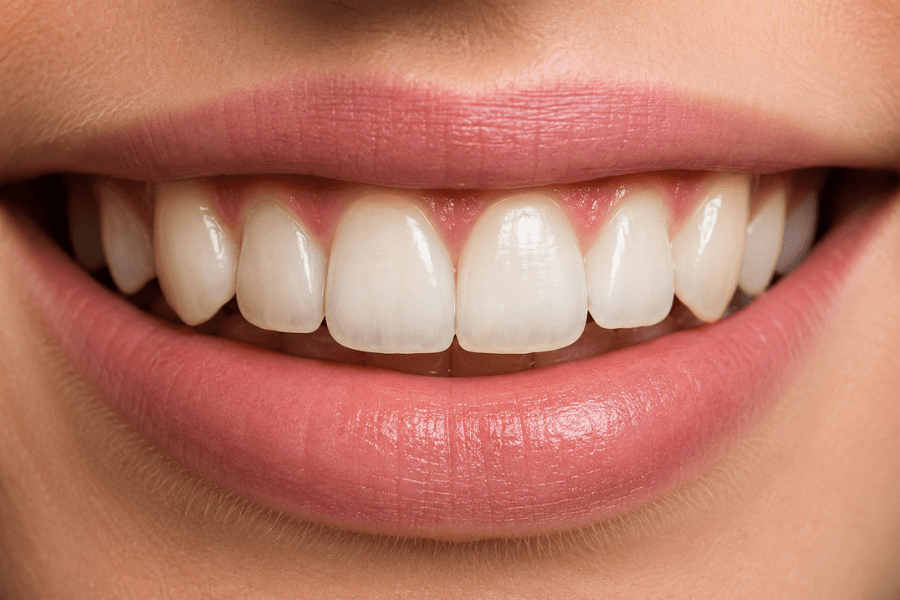
Natural color does not simply mean choosing a white shade
Color is one of the most desired elements in an aesthetic transformation, but it is also one of the easiest ways for a result to look artificial.
A natural tooth does not have a single uniform color. It presents brightness, translucency, depth, texture, and subtle variations between the area near the gums and the incisal edge. The way light passes through and reflects from the structure directly influences its appearance.
For this reason, shade selection should not be reduced to choosing the whitest option available. It is necessary to consider skin tone, lip color, lower teeth, age, personality, and the patient’s expectations.
It is also important to evaluate the substrate, meaning the color of the tooth underneath the restoration. Darkened teeth, stained teeth, or teeth with old restorations may require different strategies to achieve balance without creating an overly opaque appearance.
A bright smile can be beautiful and sophisticated. But it needs to preserve depth and integration with the face.
Texture, shine, and translucency make a difference
Naturalness does not depend only on shape and color. The surface of the teeth also plays a role in the way light is reflected.
Completely smooth teeth with uniform shine can look artificial, especially when viewed up close or under different types of lighting. A delicately planned surface, on the other hand, can reproduce depth, subtle transitions, and characteristics compatible with natural teeth.
Incisal translucency, surface gloss, and the way each restoration interacts with light need to be considered individually. Excessive opacity can make the smile look heavy. Too much translucency can also compromise predictability when the underlying tooth is darkened.
These details show why the quality of planning and execution is so important. Refinement often lies precisely in elements that do not draw attention separately, but make the overall result feel real.
The gums are a central part of planning
Veneers cannot be planned without observing the gums. They act as a frame around the teeth and directly influence their apparent height, proportion, and symmetry.
Inflammation, bleeding, recession, contour differences, or excessive gingival display can alter aesthetics and compromise treatment stability. Before any restorative procedure, it is necessary to assess whether the tissues are healthy.
It is also important to understand that changes in gingival contour can have different origins. In some cases, the appearance of the teeth is related to the position of the gums. In others, it involves tooth size, bone position, lip movement, or a combination of factors.
Placing veneers without understanding this relationship can produce disproportionate teeth or margins that are difficult to clean. For this reason, when periodontal treatment is necessary, it should be part of the planning and carried out at the appropriate stage.
A beautiful result does not depend only on ceramic. It also depends on the health and stability of the surrounding tissues.
Alignment and tooth position influence the degree of intervention
Veneers can modify shape, color, and small positional differences, but they should not be used indiscriminately to hide significant misalignment.
When a tooth is very protruded, rotated, or outside the arch, trying to correct it only with restorations may require excessive tooth reduction or create improper volume. In these cases, orthodontics can reposition the teeth and allow for a more conservative restorative stage.
In other situations, small differences may be corrected directly with composite resin or ceramic, as long as there is adequate space and function is respected.
The choice needs to consider how much structure would be removed, what the final tooth volume will be, and how the new shapes will relate to the bite.
The best path is not necessarily the fastest one. It is the one that delivers the desired result with greater preservation and stability.
Function is just as important as appearance
Veneers and dental contact lenses do not participate only in the visual aspect of the smile. They are also exposed to the forces of chewing, speech, and jaw movements.
For this reason, planning needs to evaluate the bite, tooth contacts, lateral movements, signs of wear, clenching, and bruxism. Ignoring these aspects can increase the risk of fractures, debonding, chipping, or overload on the teeth and muscles.
When a patient presents bruxism or other functional changes, it is necessary to understand the pattern of forces and plan protective measures. Depending on the case, this may involve prior treatment, adjustments, or the use of a protective device after the work is completed.
A smile that is aesthetically beautiful but unable to coexist with the patient’s function does not represent a complete result.
At Clínica Debora Ayala, aesthetics and function are evaluated together so that the transformation is not only beautiful, but also safe and predictable.
Planning helps prevent bulky teeth
One of the most common signs of an artificial-looking result is excessive tooth volume. This can happen when restorations are added without considering the available space or without making the necessary adjustments.
Teeth that are too thick can alter lip movement, make hygiene more difficult, affect speech, and create a protruding appearance. The gums may also respond negatively when contours do not favor cleaning and tissue adaptation.
To prevent this problem, it is necessary to analyze the initial tooth position and plan where volume will be added or reduced. In some cases, no tooth reduction may be necessary. In others, minimal and controlled preparation may preserve more structure than simply increasing the tooth beyond its appropriate limits.
Correct planning does not follow a generic promise of “zero reduction.” It seeks the least intervention compatible with a healthy, proportional, and natural result.
Photographs, scanning, and digital planning help improve precision
Digital resources can contribute to analyzing the smile and organizing the stages of treatment. Facial and intraoral photographs make it possible to observe proportions, reference lines, gingival display, and lip dynamics.
Intraoral scanning records the shape and position of the teeth, while digital planning can help simulate changes. Based on this information, a diagnostic wax-up, physical or digital, can be developed to represent the proposed new shapes.
These resources do not replace the clinical examination. They increase the amount of information available and make communication between the patient, dentist, and laboratory easier.
Technology helps visualize possibilities, but the result still depends on clinical interpretation, biological limitations, and personalized decisions for each case.
The mock-up allows the patient to experience the proposal
In certain treatments, a mock-up can be used to temporarily transfer the plan into the mouth. It works as a three-dimensional simulation of the possible result.
At this stage, the patient can observe the planned shape, length, and volume before the definitive restorations are made. It is also possible to evaluate how the smile behaves during speech and expression.
The mock-up does not represent an absolute guarantee of the final result because the temporary material has different characteristics from ceramic. Even so, it is an important tool for communication and adjustments.
This experience allows the patient to participate in the choices and better understand the proposal. It also helps identify necessary changes before beginning stages that may be irreversible.
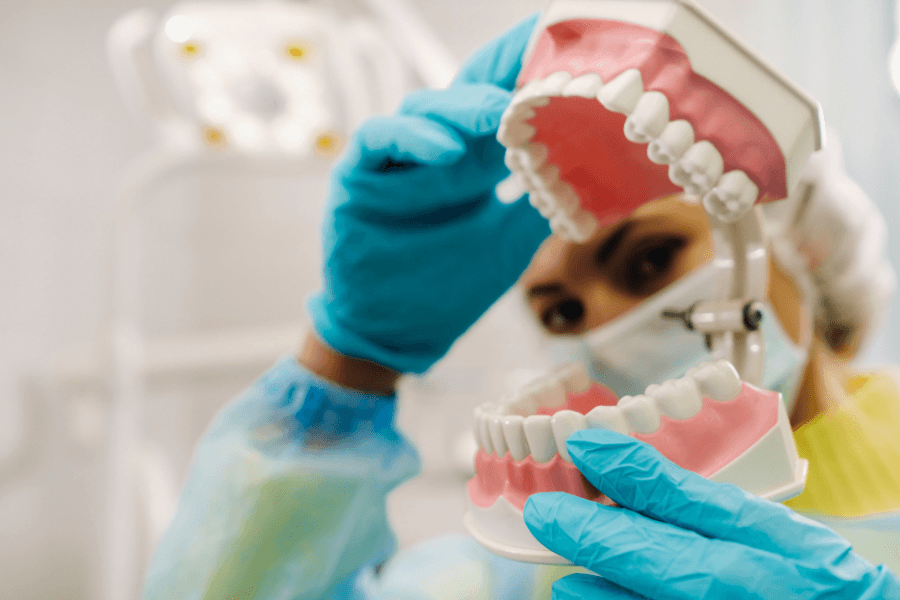
Not every case needs many veneers
The number of teeth involved should be defined by the diagnosis and by the visual impact of each area of the smile.
Some patients may need treatment on only one or two teeth with specific changes. Others present differences in color, shape, or old restorations over a larger area. There are also situations in which a combination of whitening, composite resin, and a small number of ceramic restorations produces a more conservative result than covering all visible teeth.
Recommending a large number of veneers without need may increase the biological cost and make future maintenance more difficult. On the other hand, treating too few teeth without considering the integration of color and proportions can also create noticeable differences.
The decision should consider how many teeth appear in the smile, which ones present changes, and which strategy makes it possible to achieve continuity without intervening beyond what is necessary.
Composite resin or ceramic: which is the best option?
There is no material that is universally better for every patient. Composite resin and ceramic have different characteristics, indications, and limitations.
Composite resin may allow direct repairs, simpler adjustments, and conservative interventions. Depending on the case, it can be an excellent option for small corrections of shape, spaces, fractures, or localized changes.
Ceramic offers optical properties and color stability that may be advantageous in certain treatment plans, especially when there is an indication to address several characteristics at the same time. However, its fabrication involves laboratory stages and requires rigorous planning.
The choice depends on the extent of the case, initial tooth color, bite, habits, aesthetic expectations, and the amount of available dental structure.
The treatment should be chosen for the patient. The patient should not be adapted to the material.
Veneers should not hide health problems
Before beginning an aesthetic transformation, any condition that could compromise treatment needs to be controlled.
Cavities, gingival inflammation, defective restorations, infections, undiagnosed sensitivity, and bite changes need to be evaluated. The same applies to habits and conditions that cause wear or overload.
Covering a tooth without treating the origin of the problem does not improve health. It only makes the problem harder to see.
For this reason, the aesthetic stage comes after diagnosis and the organization of oral health. In some cases, treatment may involve different phases before the veneers are placed.
This sequence does not delay the result. It creates the necessary foundation for the outcome to be more stable, safe, and predictable.
The patient participates in the choices
Aesthetic treatment planning should not be decided only by the professional or guided exclusively by a photograph brought in by the patient.
It is necessary to build a shared proposal. The patient needs to understand the possibilities, limitations, degree of change, required care, and the stages involved.
Conversations about color, shape, length, and natural appearance help align expectations. Terms such as “white,” “delicate,” or “natural” can mean different things to different people. For this reason, visual references, simulations, and tests should be accompanied by clear communication.
It is also important to explain when an expectation is not compatible with health, anatomy, or a conservative approach.
A personalized result is created when technical knowledge and the patient’s wishes meet responsibly.
What happens after veneers are placed?
Completing the procedure does not end the care. Veneers and dental contact lenses require clinical follow-up, proper hygiene, and periodic evaluations.
During follow-up appointments, the integrity of the restorations, margins, gingival response, bite contacts, and possible signs of overload are evaluated.
Although ceramics offer good aesthetic stability, they do not make teeth immune to cavities, gingival inflammation, or fractures. The dental structure still needs care, especially in the areas where the restoration joins the tooth.
Patients with bruxism or clenching also need to follow specific recommendations for protection and monitoring.
The longevity of the result depends on the quality of the planning and execution, but also on maintenance over time.
Sophistication lies in the details that do not call attention to themselves
A smile can be very bright, perfectly aligned, and symmetrical and still look artificial. This happens when the result draws more attention to the procedure than to the person.
True sophistication lies in integration. It is in the way the color works with the face, how the teeth maintain small natural differences, how the gums create a healthy frame, and how the smile moves during expression.
The best treatment is not necessarily the one that produces the greatest transformation. It is the one that identifies exactly what needs to be adjusted and preserves everything that already works.
When every decision is made with precision, the technique stops being the center of attention. What appears is the patient: lighter, more confident, and still recognizable in their own smile.
Discover how to transform your smile naturally
Well-planned veneers and dental contact lenses can modify color, proportion, shape, and balance. But they need to be indicated within a complete assessment of the face, gums, alignment, function, and identity of each patient.
At Clínica Debora Ayala, treatment planning is not about changing everything. It is about understanding which details can be refined to enhance what is already there while preserving health and structure whenever possible.
The goal is to create a result that is light, sophisticated, and coherent with who you are. A transformation that does not look artificial or disconnected from your expression.
Get in touch and schedule your personalized evaluation with Dr. Debora Ayala. Together, we will understand your expectations, evaluate the possibilities, and define the safest, most conservative, and most delicate path to transform your smile while still allowing you to recognize yourself in it.
Dr. Debora Ayala – CRO 41.974/SP
Sources:
Digital smile design for porcelain laminate veneers: clinical report. Revista Gaúcha de Odontologia. Available through SciELO at: https://www.scielo.br/j/rgo/a/kwmtpyqwgsBNZNFfKpSZWFv/. Accessed on: Aug. 6, 2026.
Nalbandian, S.; Millar, B. J. The effect of veneers on cosmetic improvement. British Dental Journal. Available at: https://www.nature.com/articles/sj.bdj.2009.609. Accessed on: Aug. 6, 2026.
Technology and emotion: A porcelain veneer case report. Dental Tribune International. Available at: https://www.dental-tribune.com/news/technology-and-emotion-a-porcelain-veneer-case-report/. Accessed on: Aug. 6, 2026.
Optimising functional and aesthetic parameters in veneer cementation. Dental Tribune International. Available at: https://www.dental-tribune.com/c/kuraray-noritake/news/optimising-functional-and-aesthetic-parameters-in-veneer-cementation/. Accessed on: Aug. 6, 2026.
Correction of the gummy smile when there is vertical growth of the maxilla and resistance to orthognathics. Revista Gaúcha de Odontologia. Available through SciELO at: https://www.scielo.br/j/rgo/a/Y8HGyFSm3pfKMvjKLDLq6Kw/. Accessed on: Aug. 6, 2026.
Perception of dentists, dental students, and patients on dentogingival aesthetics. Revista de Odontologia da UNESP. Available through SciELO at: https://www.scielo.br/j/rounesp/a/NtrbHJjgCcrvkPHwx8KWwDN/. Accessed on: Aug. 6, 2026.
Read Also
